
12 Books to Read If You Loved The Testaments
A curated list of powerful dystopian, feminist, and speculative novels for readers who loved The Testaments and want more books about resistance, control, and survival.
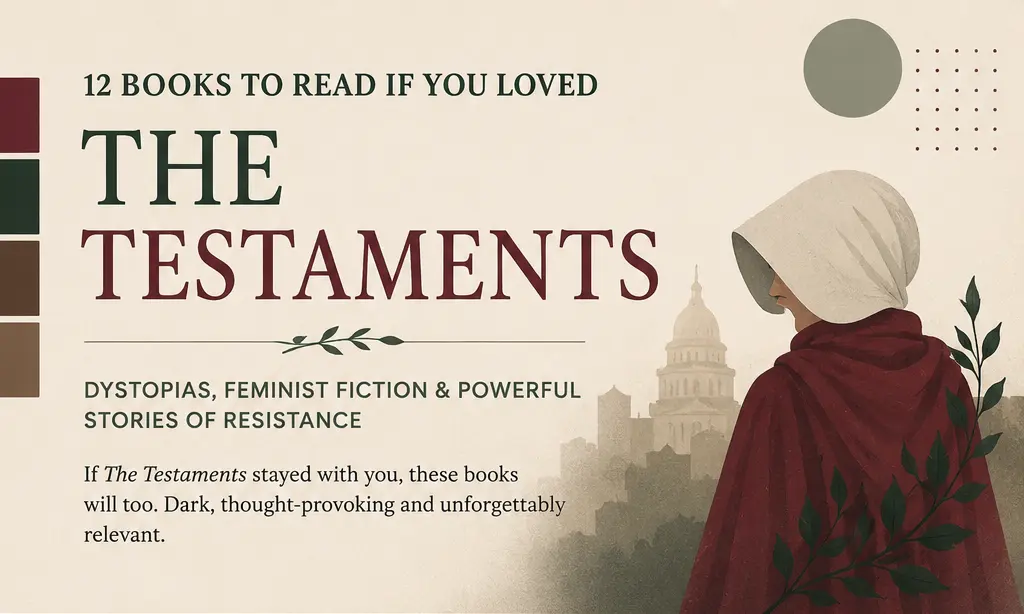
If you loved The Testaments, it probably was not only because you wanted to return to Gilead. What makes Margaret Atwood’s novel so compelling is the way it combines dystopia, political secrets, women’s voices, quiet resistance, and the unsettling feeling that an entire society can be challenged from within.
The Testaments is not just a sequel to The Handmaid’s Tale. It opens another door into Gilead, showing how power protects itself, how fear becomes routine, and how certain characters learn to survive inside a system designed to control them.
So if you finished The Testaments wanting more books with the same energy — oppressive societies, women resisting unjust systems, speculative futures, moral tension, and literary social criticism — this list is for you.
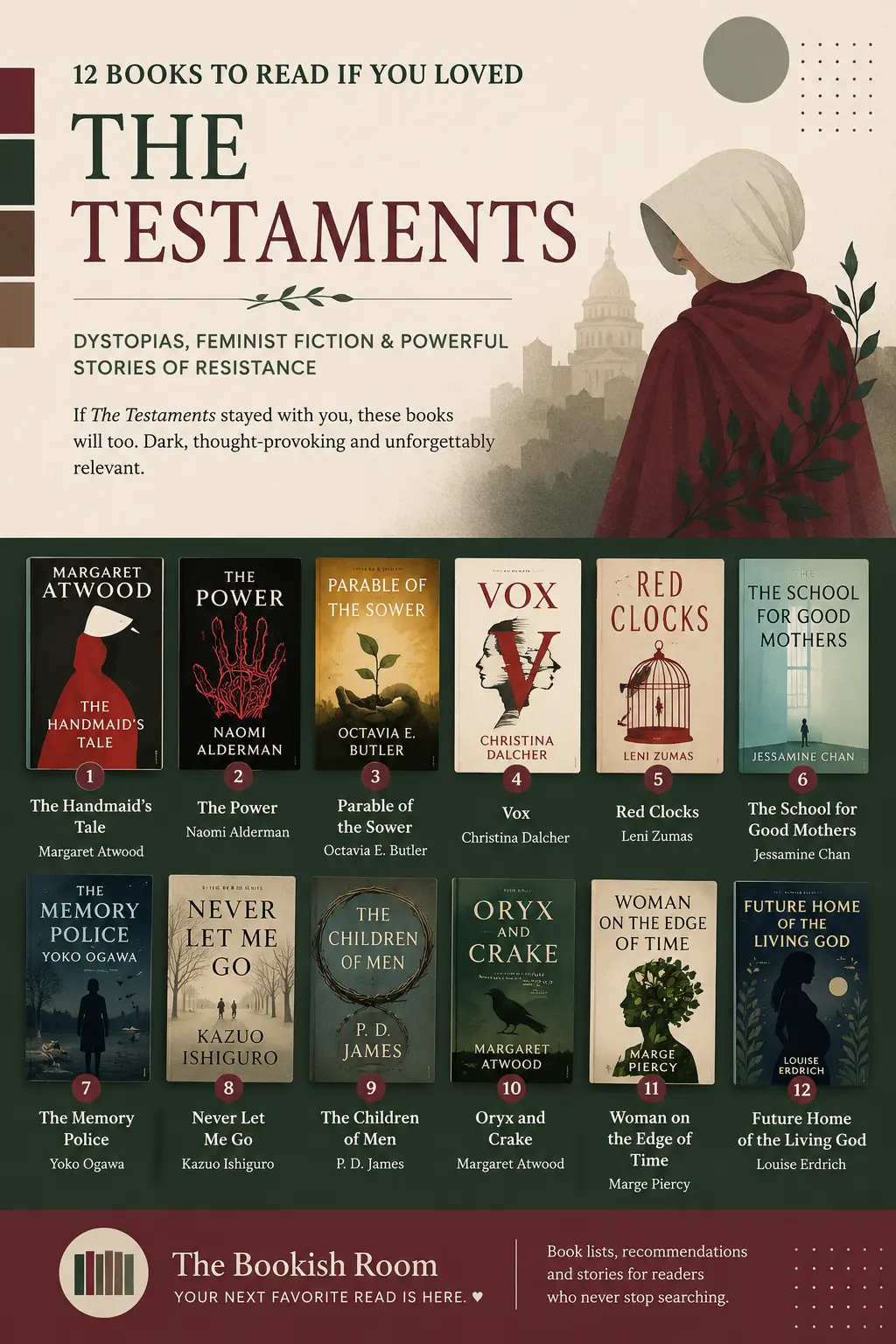
1. The Handmaid’s Tale by Margaret Atwood
If you read The Testaments before reading The Handmaid’s Tale, this is the most important place to go next.
This is the novel that first introduces Gilead, a rigid authoritarian society where women’s lives are controlled by law, religion, surveillance, and social hierarchy. Offred’s story is more intimate and more claustrophobic than the sequel, offering a quieter but deeply disturbing portrait of life under constant control.
While The Testaments expands the world and reveals more of Gilead’s inner machinery, The Handmaid’s Tale places the reader inside the emotional reality of living under that system.
Read it if you want to understand the emotional, political, and literary foundation of Gilead.
2. The Power by Naomi Alderman
The Power is one of the most natural recommendations for readers who enjoy feminist dystopian fiction. The novel begins with a simple but explosive idea: what if girls and women suddenly developed a physical power that could change the balance of power across the world?
From there, Naomi Alderman builds a story about politics, religion, violence, gender, and social reversal. But this is not simply a revenge fantasy. The deeper question is more uncomfortable: if power changes hands, does the world actually become more just?
For readers of The Testaments, the appeal lies in the way Alderman examines systems. Like Atwood, she understands that oppressive societies are not built from nowhere. They grow from fear, belief, control, and the human ability to normalize almost anything.
Read it if you want a provocative dystopia with strong political energy and a difficult moral question at its center.
3. Parable of the Sower by Octavia E. Butler
If Gilead is frightening because it feels politically possible, Parable of the Sower is frightening because it feels socially possible.
Octavia E. Butler imagines a near future shaped by economic collapse, instability, violence, and communities trying to survive in a world that is coming apart. The protagonist, Lauren Olamina, is a young woman with a powerful new spiritual and philosophical vision, moving through a broken society while trying to imagine something beyond it.
The novel has a different energy from The Testaments. Instead of showing a regime already firmly in place, it follows a world in the process of collapse. But the central questions are similar: how do people survive when institutions fail? How do you hold on to humanity when fear becomes the dominant force?
Read it if you want a visionary, intense, socially grounded dystopia.
4. Vox by Christina Dalcher
Vox is a direct and high-concept dystopia: in a new political order, women are limited to a fixed number of spoken words per day.
Christina Dalcher uses this premise to explore language, silence, family, obedience, and resistance. It connects strongly with Atwood because it turns a symbolic form of oppression into a concrete rule. In Gilead, controlling reading, writing, bodies, and identity is a way of controlling the world. In Vox, controlling speech becomes a way of controlling women’s public and private existence.
The novel is faster and more thriller-like than Atwood’s work, but it touches many of the same themes: authoritarianism, complicity, the gradual loss of rights, and the danger of realizing too late how far things have gone.
Read it if you want a feminist dystopia with a strong premise and a quick, tense pace.
5. Red Clocks by Leni Zumas
Red Clocks is an excellent choice for readers who were drawn to the political and bodily stakes of The Testaments.
The novel imagines an alternate America where reproductive rights have been restricted. It follows several women whose lives are shaped by motherhood, desire, loneliness, social judgment, and personal choice in a country that has turned private decisions into matters of public control.
This book is less of a thriller and more of a literary dystopia. Its power lies in the way it follows ordinary women living inside an oppressive political structure. There is not just one central heroine. There are multiple lives being pressed down by law, expectation, and moral surveillance.
Read it if you want a literary, feminist, emotionally mature dystopia.
6. The School for Good Mothers by Jessamine Chan
In The School for Good Mothers, a mother makes a mistake during a moment of exhaustion and is sent to an institution that claims to retrain women judged to be inadequate mothers.
The premise is deeply uncomfortable because it turns social judgment into an official system of monitoring and punishment. The novel explores motherhood, guilt, race, technology, institutional power, and the way systems can use the language of care to justify control.
For readers of The Testaments, the connection is clear: authoritarian systems do not always present themselves as cruelty. Sometimes they present themselves as protection, morality, education, or order.
Read it if you want a contemporary dystopia about motherhood, surveillance, and institutional control.
7. The Memory Police by Yoko Ogawa
The Memory Police is a quieter, stranger, more poetic dystopia. On an unnamed island, objects and memories begin to disappear. Most people accept these losses gradually, while a mysterious police force ensures that forgetting continues.
The novel does not have the direct political structure of The Testaments, but it shares one essential fear: the fear of a society that learns to obey the disappearance of reality.
Yoko Ogawa creates an atmosphere of melancholy, silence, and soft threat. It is a book about memory, language, loss, and inner resistance. Where Atwood writes about regime, testimony, and power, Ogawa writes about erasure, absence, and forgetting.
Read it if you want a delicate, literary, deeply unsettling dystopia.
8. Never Let Me Go by Kazuo Ishiguro
Never Let Me Go is one of the most elegant and emotionally devastating dystopian novels of contemporary literature.
The novel follows Kathy, Ruth, and Tommy, who grow up in what first appears to be an ordinary boarding school. Slowly, the reader begins to understand the true purpose of their world. Ishiguro does not build his dystopia through dramatic political explanation. Instead, he shows people who have grown up inside a cruel system and learned to treat it as normal.
That is the strongest connection to The Testaments. In Gilead, a new generation grows up without fully knowing the world that came before. In Never Let Me Go, the tragedy also comes from the normalization of the unthinkable.
Read it if you want a sad, elegant, deeply human dystopia.
9. The Children of Men by P. D. James
In The Children of Men, humanity faces an absolute crisis: people have stopped having children. Without a biological future, society begins to decay politically, spiritually, and emotionally.
The novel combines dystopia, philosophy, religion, and suspense. Like Atwood, P. D. James is interested in what happens when the body, reproduction, and the future become matters of state power.
It is a fascinating read for anyone who liked The Testaments, because fertility and social control are central to both books. The tone, however, is different: darker, more contemplative, and distinctly British.
Read it if you want a classic dystopia about infertility, power, and social collapse.
10. Oryx and Crake by Margaret Atwood
If you want to keep reading Margaret Atwood but step outside Gilead, Oryx and Crake is one of the strongest next choices.
Here, Atwood turns toward biotechnology, environmental collapse, corporate science, consumer culture, and the end of a certain idea of humanity. The novel follows Snowman in a devastated future, while memories of the past slowly reveal how that future was created.
The connection to The Testaments lies in Atwood’s cool, intelligent view of the systems that make catastrophe possible. She does not write impossible futures. She takes real tendencies and pushes them a few steps further.
Read it if you want a darker, more scientific, more ambitious speculative dystopia.
11. Woman on the Edge of Time by Marge Piercy
Woman on the Edge of Time is an important work of feminist speculative fiction. The novel follows Connie, a marginalized woman who begins to experience contact with a possible future society organized in radically different ways from her own world.
The book blends social criticism, utopia, dystopia, mental health, gender, class, and political imagination. It is more experimental than some of the other books on this list, but it is extremely rewarding for readers interested in speculative fiction as a tool for social critique.
While The Testaments shows an authoritarian society trying to control women, Woman on the Edge of Time asks what other worlds might be possible if social structures were built differently.
Read it if you want a bold, political, visionary feminist novel.
12. Future Home of the Living God by Louise Erdrich
Future Home of the Living God combines dystopia, pregnancy, spirituality, identity, and biological crisis. Its protagonist, Cedar, is pregnant at a moment when human evolution appears to be shifting, and the state begins monitoring pregnant women in the name of collective survival.
It is hard not to think of Atwood when reading this premise. Once again, the female body becomes political territory, and motherhood becomes a site of fear, surveillance, and power.
Louise Erdrich brings her own texture to the story, with a strong interest in ancestry, faith, belonging, and identity. The result is a dystopia that feels intimate, strange, and spiritually charged.
Read it if you want a story close to Atwood in theme, but with a different literary and emotional atmosphere.
Where should you start?
If you want something closest to The Testaments, start with The Handmaid’s Tale, Vox, Red Clocks, or The School for Good Mothers.
If you want a more literary and emotional dystopia, choose Never Let Me Go or The Memory Police.
If you want something broader, more political, and more visionary, try Parable of the Sower, The Power, or Woman on the Edge of Time.
If you want to stay inside Margaret Atwood’s speculative imagination, choose Oryx and Crake.
Final thoughts
What makes The Testaments so powerful is not only the return to Gilead. It is the feeling that every society carries, somewhere within itself, the possibility of becoming something else: more rigid, more fearful, more controlling, more silent.
The books on this list follow that same unsettling path. Some are political, some are literary, some are emotional, and some are more speculative. But all of them ask a similar question: what happens when power decides to control private life? And what can still resist when almost everything seems lost?
For readers who loved The Testaments, these novels offer new ways into worlds that are intelligent, disturbing, and very hard to forget.
Books in This List
The Testaments
by Margaret Atwood · 2019
Set years after The Handmaid's Tale, The Testaments expands the world of Gilead through multiple voices and a closer look at power from inside the system.
The Handmaid's Tale
by Margaret Atwood · 1985
In the Republic of Gilead, Offred lives under a rigid authoritarian society that controls women's bodies, language, relationships, and memory.
Oryx and Crake
by Margaret Atwood · 2003
In a devastated future shaped by biotechnology, corporate greed, and ecological collapse, Snowman remembers the brilliant and dangerous figures of Oryx and Crake.